Scotland Getaways
• Personal / Self initiated • vibe coding •
A personal luxury deal scout
Scotland Getaways is a personal deal discovery platform built to solve a real, recurring frustration: missing luxury spa breaks and hotel offers that disappear before I notice them. Most travel sites are built for booking. This was built for monitoring.
Scotland Getaways is a personal deal discovery platform built to solve a real, recurring frustration: missing luxury spa breaks and hotel offers that disappear before I notice them. Most travel sites are built for booking. This was built for monitoring.
My Role
A deliberately experimental approach to product-building. I owned the product direction, UX decisions, and quality — and used AI as the engineering partner throughout.
- Product Manager
- Product Designer
- QA Tester
- Strategic decision maker
- Source auditor
- Technical architect
- Code implementation
- Debugging asistant
- Infrastructure setup
The Problem
I regularly save travel ideas — spa hotels, getaway venues, places I want to visit — but consistently miss the moments when good offers appear. The existing deal landscape had real gaps:
- Deals appear and disappear within 24–48 hours
- I don't remember to check websites regularly
- Notifications from deal sites are generic and poorly targeted
- Most travel sites optimise for booking, not monitoring
- No tool watched my specific wishlist venues
Build Process
Basic Deal Aggregation
The first version built a deal database that scraped multiple travel sources, normalised offers into a common structure, scored deals by value, and displayed them in a searchable grid. Data was stored in SQLite. Functionally, it looked like a working product.
The Core Promise Was Brokens
The product looked complete but was fundamentally failing its own brief. It wasn't a scout — it was just a searchable list I had to remember to update. This became the immediate highest priority.
Solution — Automatic Monitoring Architecture
Implemented a launchd-based monitoring system that runs automatically, survives Mac restarts, and requires no manual interaction. Four daily scans were scheduled:

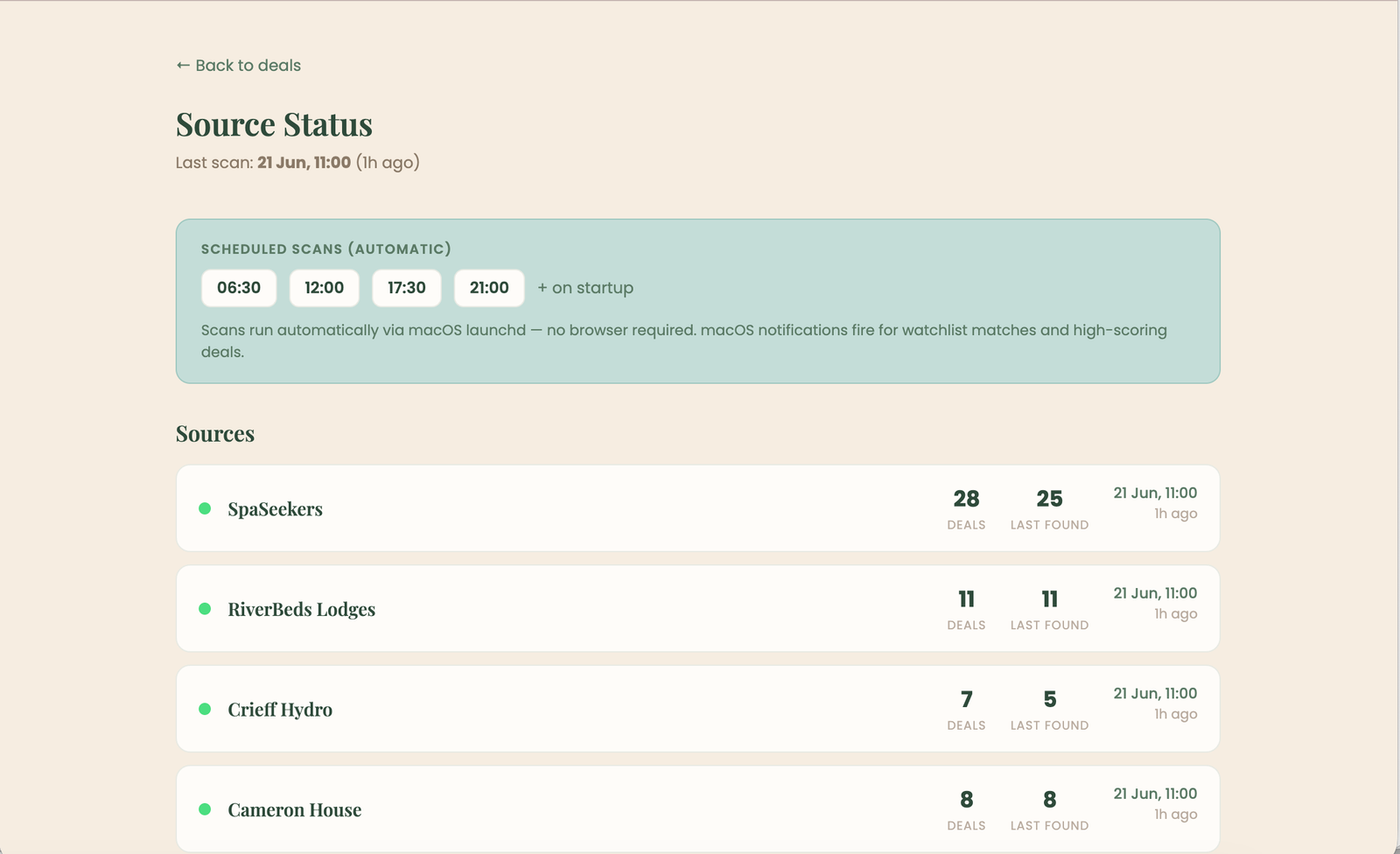
Source Status — live scan log showing all sources checked automatically, deal counts, and timestamps. No browser required
Notification System — And Why It Wasn't Working
The notification system was built but completely silent. After investigation, the root cause was a date format mismatch between SQLite and JavaScript that meant the query never matched newly inserted deals.
SQLite stored: 2026-06-05 16:30:00
JS compared: 2026-06-05T16:30:00Z
Query never matched. Notifications had effectively never fired.
Moved all date filtering into SQLite datetime functions
Added permanent deduplication — each deal notifies once only
Three tiers: watchlist · high-value · standard
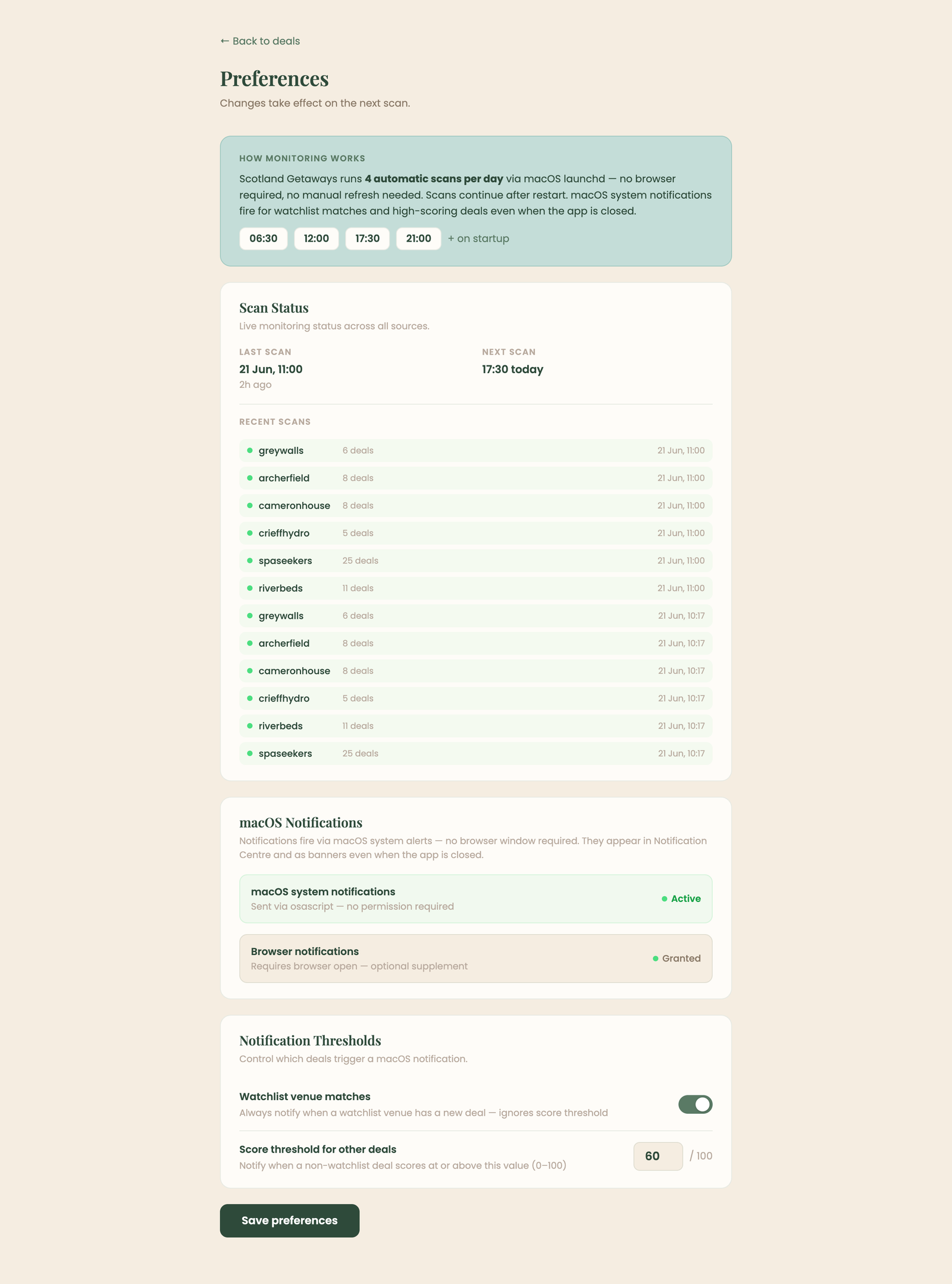
Preferences — scan schedule, macOS notification status, and adjustable score threshold for what triggers an alert
Source Quality Audit
A full audit of all data sources revealed that several were placeholder or mock implementations contributing no real deals. These were removed and replaced with genuine Scottish luxury venue integrations.
Secret Escapes (mock)
Groupon (placeholder)
VisitScotland (placeholder)
Archerfield House
Crieff Hydro
Greywalls
RiverBeds Lodges
SpaSeekers
Watchlist System
Added venue and location-level tracking so the system could prioritise the places I genuinely care about — boosting their scores, surfacing them first, and triggering priority notifications the moment a matching deal appears.
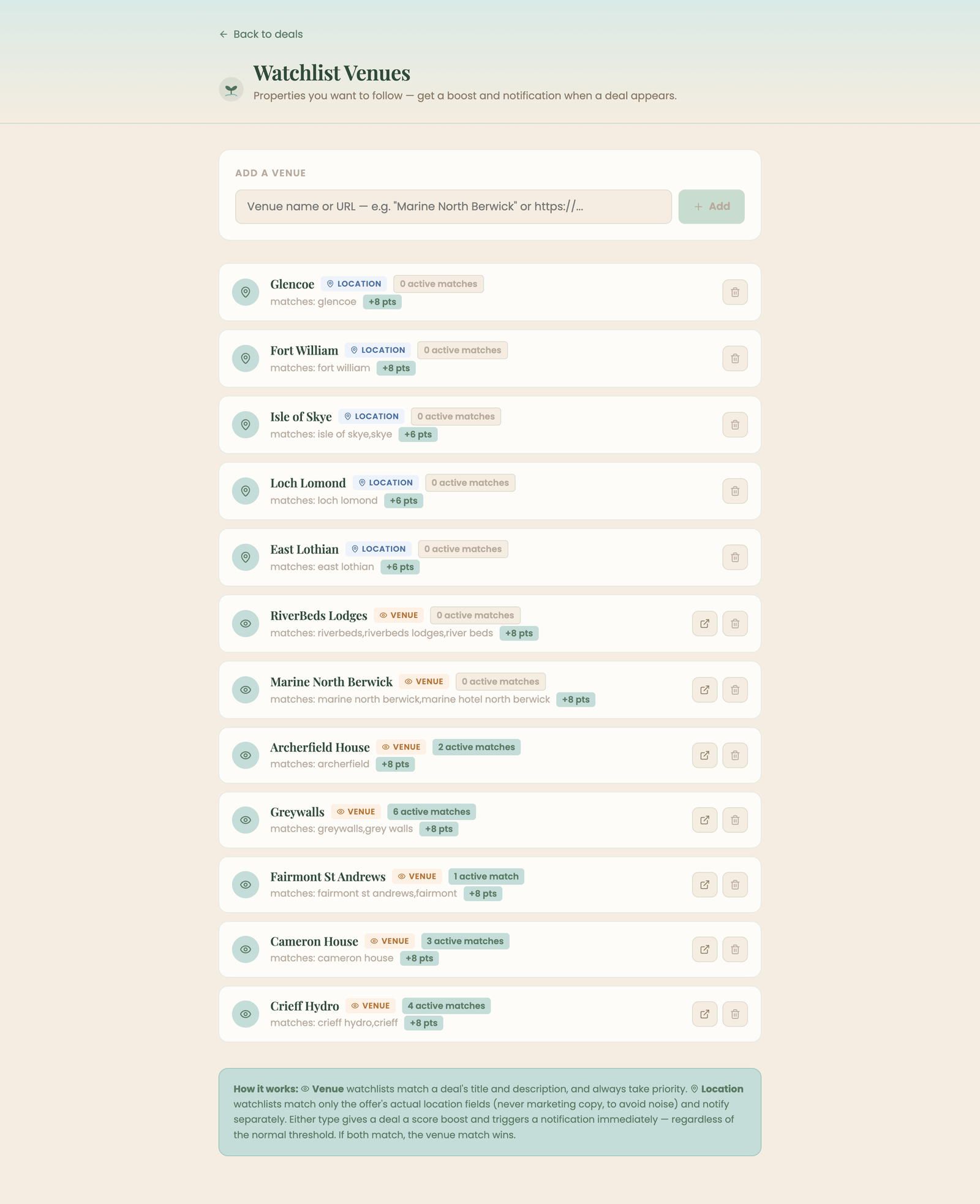
Watchlist Venues — tracks both specific venues (Archerfield, Cameron House, Crieff Hydro) and locations (Glencoe, Isle of Skye). Shows active match counts and score boosts per entry
Feed Quality — Expired Deal Problem
Over time, expired deals accumulated permanently. Old Black Friday offers, winter promotions, and seasonal packages remained visible long after they'd gone. A source reconciliation process was added to every scan.

Each scan now reconciles live source data against the database — only currently active deals remain visible
UX Redesign
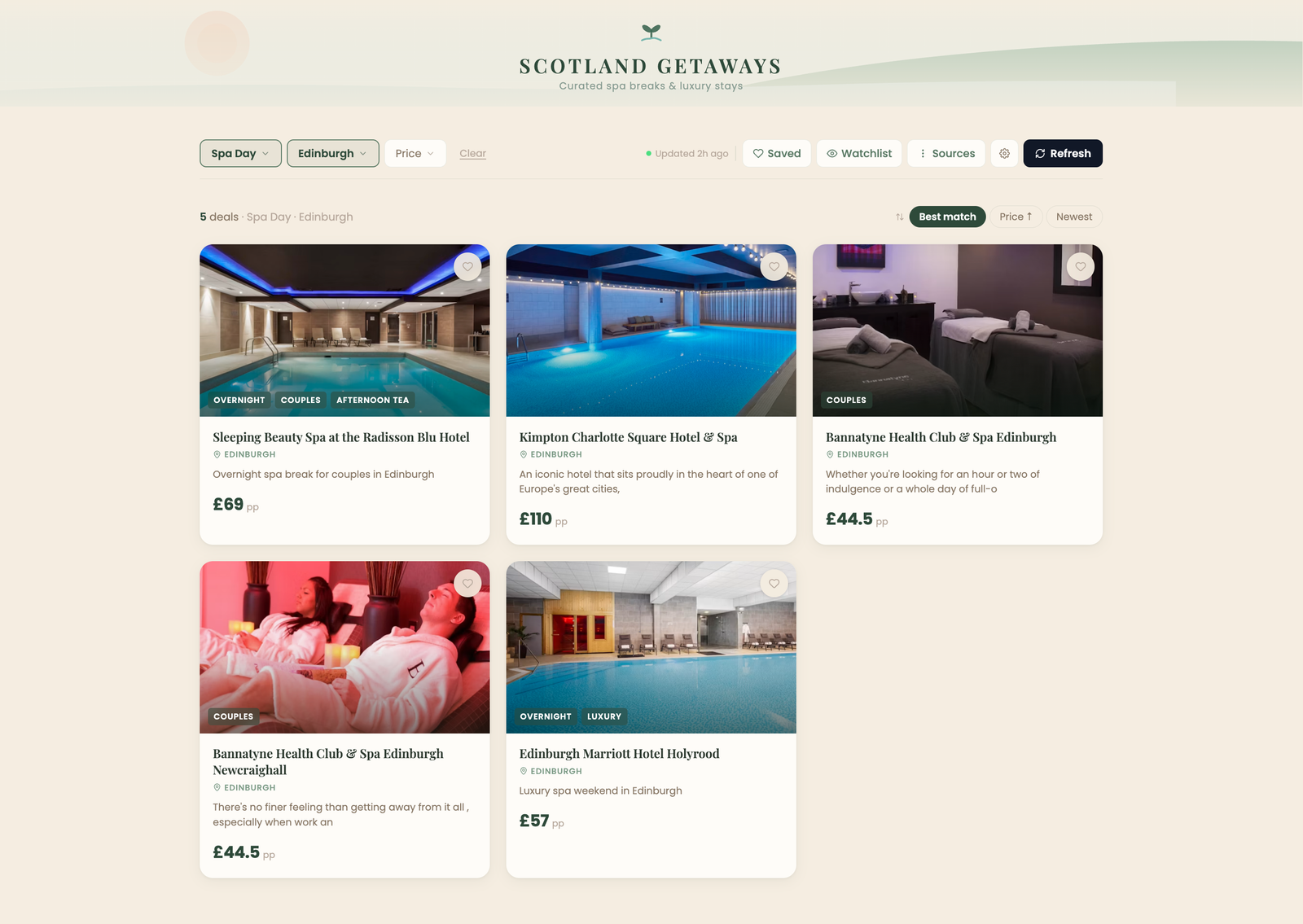
The initial interface had grown organically and it showed. Filters were oversized, navigation was inconsistent, and the preferences panel still referenced features that had never shipped. A full redesign addressed all of it.
Oversized filter chip rows dominating the page
Poor use of vertical space
Inconsistent navigation patterns
Preferences full of orphaned settings
Compact dropdown filters in a unified toolbar
Toolbar: filters · scan status · nav · refresh
Refined wordmark & botanical icon
Preferences rebuilt around real behaviour
Key Product Lessons
The biggest breakthrough came from stepping back and questioning whether the product was actually doing what I thought it was. It wasn't. Building the habit of auditing before iterating changed how I approached every subsequent phase.
Placeholder sources made the database look full and the product feel functional. Replacing them with real venue data immediately exposed what was actually valuable — and what wasn't.
Users don't want another place to look. They want the system to do the looking and tell them when it matters. That insight is transferable to almost any product where the user has recurring intent but limited attention.
The AI could implement anything I described. But it couldn't tell me what to prioritise, what to cut, or when something was fundamentally broken. That judgment is still the designer's job.
Current State
The platform now runs autonomously. It scans four times daily, survives restarts, removes expired deals automatically, tracks a watchlist of venues and locations, and sends macOS notifications when something worth seeing appears — all without any manual input.
Future opportunities
- Screenshot-to-watchlist workflow
- Personalised scoring based on past saves and behaviour
- Mobile companion app
- Better expiry detection for time-sensitive deals
- Expanded venue imagery